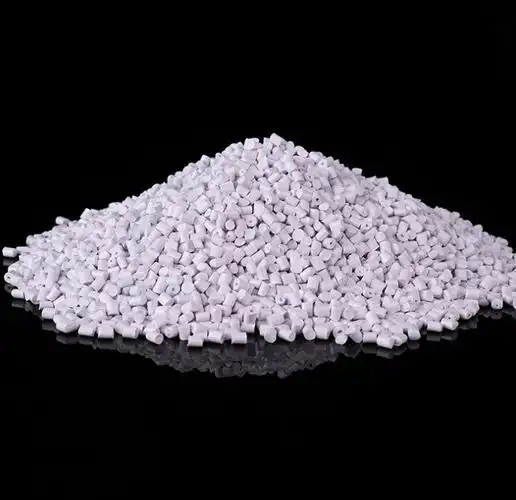
1.What is White Masterbatch and Its Core Characteristics
White masterbatch is a concentrated coloring additive widely used in the plastic production industry, mainly composed of high-purity titanium dioxide (TiO2), carrier resin, dispersant, anti-aging agent, and whitening agent. It is processed by high-temperature mixing, extrusion, and granulation, which solves the problems of uneven dispersion, easy yellowing, and poor whiteness stability of traditional white pigments in production.
With high whiteness (whiteness value ≥93%), excellent dispersion, good heat resistance (up to 300℃), and strong weather resistance, white masterbatch is non-toxic, odorless, and meets international environmental and safety standards such as FDA, RoHS, and REACH. It is an indispensable auxiliary material in modern plastic production, providing uniform and stable whiteness for products while optimizing processing performance.
2.Key Application Fields of White Masterbatch in Production
White masterbatch is favored by manufacturers for its stable whiteness, easy use, and wide compatibility, and its application covers almost all plastic production fields:
1. Plastic pipes production: It is widely used in PE, PPR, PVC, and MMP pipes. Adding white masterbatch not only gives the pipes a clean and bright white appearance but also enhances their UV resistance and anti-aging performance, effectively preventing yellowing and brittleness of outdoor pipes, which is suitable for municipal, agricultural irrigation, and building plumbing pipes.
2. Packaging industry: It is the core coloring material for food packaging, cosmetic packaging, medical packaging, and daily necessities packaging. High-purity white masterbatch with food-grade certification ensures the whiteness and cleanliness of packaging, meets food contact safety standards, and improves product grade and market competitiveness.
3. Injection molding products: Used in the production of plastic toys, home appliance shells, plastic containers, and auto parts. White masterbatch ensures uniform whiteness of products, no color spots or streaks, and enhances the surface smoothness of products, making them more attractive in appearance.
4. Film and fiber industry: Applied in agricultural film, packaging film, and textile fibers. White masterbatch improves the whiteness and opacity of films, enhances light reflection performance of agricultural film, and makes textile fibers brighter and more durable without fading.
3.Advantages of Using White Masterbatch in Production
Compared with direct addition of titanium dioxide powder, using white masterbatch in production has obvious advantages, which can effectively improve production efficiency and product quality:
1. Uniform whiteness and dispersion: The professional dispersant in white masterbatch ensures that titanium dioxide is evenly dispersed in the base material, avoiding color spots, streaks, and agglomeration, and ensuring consistent whiteness of each batch of products.
2. Easy to use and clean: White masterbatch is granular, easy to store, transport, and feed, which reduces dust pollution in the production process, optimizes the operating environment, and simplifies the production process.
3. Stable performance and anti-yellowing: It contains anti-aging and whitening agents, which can effectively prevent products from yellowing due to sunlight, high temperature, and long-term use, ensuring long-term whiteness stability.
4. Cost-saving and high efficiency: The addition ratio of white masterbatch is 2%-5% (adjustable according to whiteness requirements), which can reduce the waste of titanium dioxide, control production costs, and improve production efficiency.
4.Key Tips for Selecting White Masterbatch in Production
To ensure the whiteness effect and product quality, the following points should be paid attention to when selecting white masterbatch:
1. Purity of titanium dioxide: Choose white masterbatch made of high-purity rutile titanium dioxide (purity ≥98%), which has better whiteness, hiding power, and weather resistance than anatase titanium dioxide.
2. Compatibility: Select white masterbatch matching the base material (such as PE-specific, PPR-specific, PVC-specific) to ensure good dispersion and no impact on the processing performance of products.
3. Whiteness and hiding power: Focus on the whiteness value (preferably ≥93%) and hiding power, and select products that meet the appearance requirements of the final product.
4. Certification and safety: Choose products with FDA, RoHS, REACH and other certifications, especially food-grade and medical-grade white masterbatch for packaging and medical products, to ensure compliance with safety standards.
Conclusion
White masterbatch is an essential high-performance additive in modern plastic production, with the advantages of uniform whiteness, good dispersion, stable performance, and wide compatibility. It not only provides a clean and bright appearance for products but also enhances product durability and safety, and optimizes the production process to reduce costs.
For manufacturers, choosing high-quality white masterbatch and selecting the appropriate type according to the base material and product requirements is the key to ensuring product quality, improving market competitiveness, and achieving efficient and cost-effective production.
Q1: What materials are compatible with white masterbatch?
A1: White masterbatch is compatible with PE, PPR, PVC, ABS, PC, PET and other plastic materials, suitable for injection molding, extrusion, blow molding and other processes.
Q2: What is the addition ratio of white masterbatch in production?
A2: The general addition ratio is 2%-5%, which can be adjusted according to the required whiteness and product thickness.
Q3: Is white masterbatch suitable for food packaging production?
A3: Yes. Choose food-grade white masterbatch with FDA certification, which is non-toxic, odorless and meets food contact safety standards.
Q4: How to avoid yellowing of products using white masterbatch?
A4: Choose white masterbatch with anti-aging and whitening agents, and avoid direct sunlight during storage and use.
Q5: What is the difference between rutile and anatase white masterbatch?
A5: Rutile white masterbatch has higher whiteness, hiding power and weather resistance, suitable for outdoor and high-demand products; anatase is suitable for indoor low-demand products.
Post time: Apr-07-2026
